
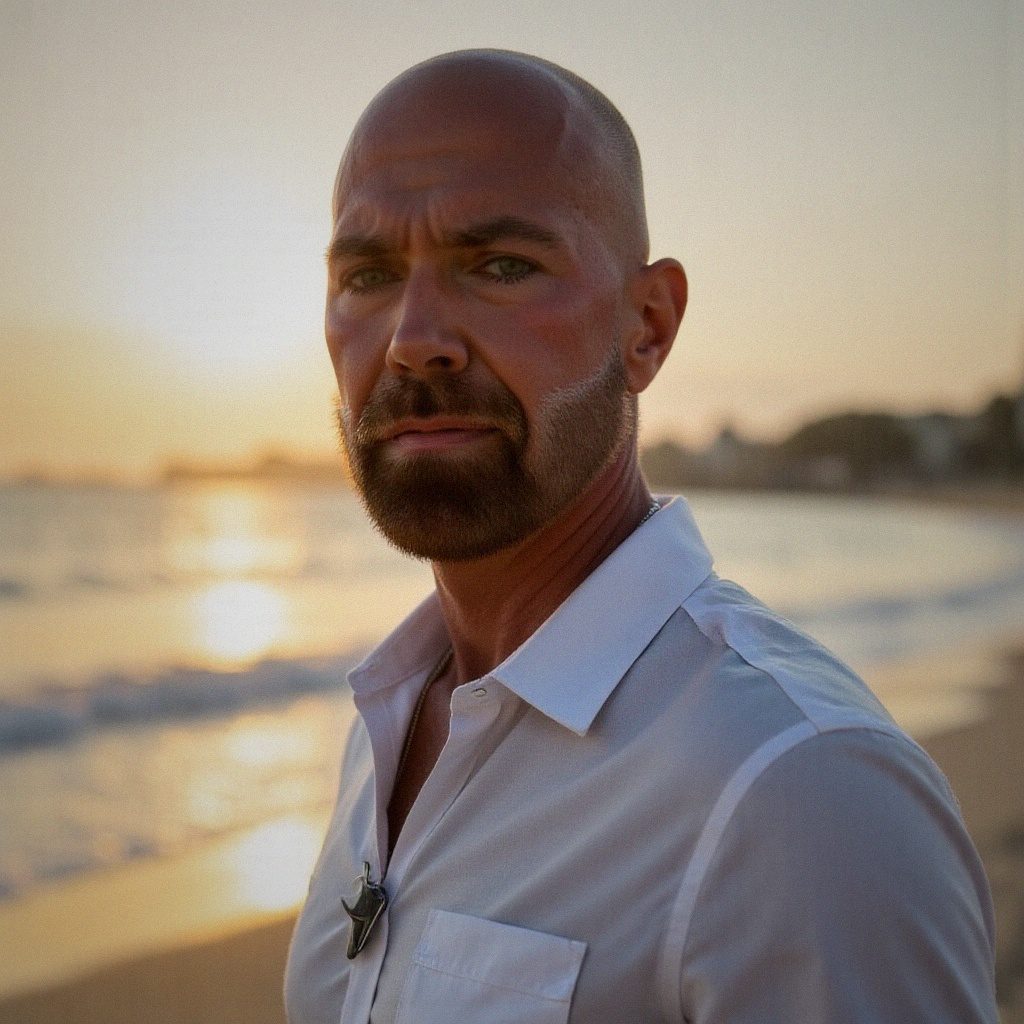
WiLL R. Young, CFP® is a Behavioral Architect, published author, practicing Stoic, international animal rescuer, and avid surfer.
— equally at home in a deep conversation about cognitive bias as he is paddling into a reef break.
When he is not working, you will find him in the water — beach breaks in Costa Rica, reef on the North Shore of Hawaii, Puerto Rico, and Bali.
His life outside the office runs on the same philosophy as his work: show up fully, think clearly, and leave things better than you found them. That has meant rescuing dogs locally and in Peru, and working with orangutans in Borneo.
This December he heads to Queensland, Australia for his next adventure — rehabilitating flying fox bats during baby season, when the youngest and most vulnerable need the most hands.
The thread running through all of it — the philosophy, the frameworks, the waves, the animals — is simple: a life well lived is measured by attention, virtue, and the depth of your presence in it.
Philosopher. Surfer. Animal Rescuer. Superforecaster. Author.
A practicing Stoic who reads Epictetus at 4AM, paddles into reef breaks on the North Shore, and spends his Decembers rehabilitating flying fox bats in Queensland.
And in conversation — undefeated.
Through a 7-step protocol built on decades of behavioral research, WiLL has an uncanny ability to do what most people never see coming: peel back the layers of what someone believes they know, until the Illusion of Information Adequacy reveals itself. The moment a person discovers the gap between their perceived competence and their actual decision-making capacity — that is where the real work begins.
He does it without ego. Without judgment. With complete equanimity.
Not to win. To illuminate.
The same discipline that carries him through heavy water is the same discipline he brings to every conversation — the belief that clear thinking, honest self-examination, and the courage to say I don't actually know are not weaknesses.
They are the beginning of wisdom.
Key Achievements:
The Cognitive Cascade Decoder™ A original framework mapping the full sequence of human cognitive error — from mental shortcut to bias to fallacy to behavioral effect to psychological phenomenon to illusion. Built from 15+ years of documented behavioral research and applied in real-time conversation.
The Belief & Claim Reasoning Protocol A 7-step framework for stress-testing beliefs and calibrating confidence — built on Philip Tetlock's superforecasting methodology and Brier score tracking. Designed to answer the one question most people never ask: what would change your mind?
The Complete Cognitive Bias Compendium A publication-quality reference documenting the full landscape of cognitive bias — named, defined, mapped, and cross-referenced. Built as both a personal research tool and a living educational resource.
The Discipline of Clear Thinking
"Letters to Lucilius" — Seneca
Seneca wrote that most human suffering comes not from what happens to us, but from what we imagine might happen. The mind, left unchecked, will always choose the story over the evidence.
This is where behavioral science meets Stoic philosophy.
Human psychology follows predictable patterns of error — overconfidence, loss aversion, herd mentality, affective forecasting. We feel our way to conclusions and then build the reasoning around them afterward, convinced we were rational all along.
WiLL's 7-step protocol is designed for exactly this moment — to slow the cascade, name the bias, and return the mind to what is actually known versus what is merely felt.
Seneca again: "It is not that I am brave. It is that I know what is worth fearing."
That clarity — earned through honest self-examination and rigorous thinking — is the foundation of every decision made well.
The Ocean Doesn't Care What You Think
There is no negotiating with a reef break on the North Shore. No arguing with a closing set in Bali. No amount of confidence, credential, or preparation changes what the ocean decides to do in the next ten seconds.
What you control is everything that came before that moment.
The hours in the water before you ever saw that wave. The positioning — where you sit in the lineup, how you read the horizon, which direction the swell is moving. The setup — angle of the board, weight distribution, where your eyes are locked. The paddle — timing, commitment, the decision to go or pull back. The practice that made all of it instinct. The patience to wait for the right wave and let a hundred wrong ones pass. The equanimity to wipe out, surface, and paddle back to the peak without a story about it.
WiLL has chased waves from Puerto Rico to Costa Rica, California to the North Shore of Hawaii, Bali to the Atlantic shore — each break with its own rhythm, its own consequence, its own demand for presence and preparation.
The ocean teaches what Seneca already knew: most suffering comes from the story we tell ourselves before the wave arrives.
Watch the horizon. Read what is actually there. Position early. Commit fully. And when it closes out — surface, paddle back, and go again.
Not because the ocean got easier.
Because you got clearer.
You cannot control the wave. You control everything you bring to it.
The Water We Swim In
Epictetus was a slave. He owned nothing. Controlled nothing — except his mind. And from that single point of control, he built a philosophy that has outlasted every empire that surrounded him.
That is Stoicism. Not detachment. Not indifference. The radical, disciplined act of knowing exactly where your attention belongs — and placing it there, every single time, no matter what the water is doing.
WiLL has sat in lineups from Bali to the North Shore, waited out animal rescues from Peru to Borneo, competed against the world's sharpest analytical minds in superforecasting, and spent thousands of hours mapping the exact moment a human mind begins to deceive itself.
The through line in all of it is the same.
You cannot control the reef. You cannot control the weather. You cannot control what a flying fox bat does at 3AM in Queensland. You cannot control what another person believes, or how a cascade of cognitive bias has already shaped their certainty before the conversation begins.
What you can control — always, only, entirely — is the quality of your attention. The honesty of your thinking. The discipline of your preparation. The equanimity you carry into the moment when everything gets loud.
Seneca wrote: "If you really want to escape the things that harass you, what you need is not to be in a different place, but to be a different person."
That is the work. In the water. In the field. In the conversation. In the mirror at 4AM with Epictetus open on the table.
Everything WiLL has built — the Cognitive Cascade Decoder, the Belief & Claim Reasoning Protocol, the 7-step framework that peels back the Illusion of Information Adequacy — exists because of one belief:
Clear thinking is not a talent. It is a practice. And practice, done with virtue and discipline, becomes character.
The wave does not care who you are. Neither does the bias. Neither does the clock.
Show up anyway. Prepared. Present. Undefeated.
Core Stoic Principles Applied:
Concentrate on controllable factors such as risk management and emotional response
Accept market fluctuations as inevitable and outside one’s control
Maintain internal stability to make clearer, more confident decisions
No One Paddles Out Alone
The best surfers in the world have coaches. They watch film. They sit on the beach and study the break with people who have surfed it longer, deeper, and in heavier conditions than they have.
Wisdom is not a solo pursuit.
Epictetus learned from Musonius Rufus. Marcus Aurelius filled his Meditations with gratitude for every teacher who sharpened his thinking. Seneca wrote letters — thousands of them — because he understood that the examined life requires another mind to examine it with you.
The people around you are not a luxury. They are part of the practice. The ones who ask hard questions. Who have sat in uncertainty longer than you have. Who will tell you the truth about what they see — not what you want to hear.
That is the community worth building. Not one that confirms what you already believe. One that makes you think more clearly than you could alone.
Iron sharpens iron. The water humbles everyone equally.
Unlock Valuable Insights
Grounded in Nobel laureates Kahneman and Tversky’s research, his work empowers clients to understand their biases and invest with greater confidence and resilience. Want to learn more?